Beyond the Training Manual: Why Immersive Learning Is Changing Industrial Training
Published: Sep 01, 2026 • Author: CITPL Engineering Team
Beyond the Training Manual: Why Immersive Learning Is Revolutionizing Industrial Training
#### What if your employees could make their first mistake before they ever touched a real machine?
That single question is reshaping how manufacturers, energy companies, and aerospace firms approach workforce development. Because here's the hard truth every industrial trainer knows: reading a manual is not the same as being ready.
You can hand someone a 50-page SOP. You can walk them through slides. You can show them videos of experienced operators. But when that employee finally stands in front of live equipment - with pressure, noise, and real consequences - the gap between knowing and performing becomes painfully clear.
That gap is exactly what immersive learning was built to close.
The Real Problem? Information Overload. The Real Need? Experience.
Most industrial organisations don't lack training content. They have manuals, checklists, presentations, and veteran trainers. What they lack is repeatable, hands-on exposure - the kind that builds muscle memory and real confidence.
Think about a safety-critical procedure. Reading "identify the anomaly → isolate the line → execute emergency shutdown" takes seconds. But doing it correctly under simulated pressure? That requires practice. And practice on real equipment is expensive, risky, or simply impossible when production can't stop.
That's where VR industrial training and Mixed Reality solutions become game-changers.
VR Training: Turning "What If" Into "Watch Me"
With Virtual Reality, employees step into a fully digital replica of their workplace - and interact with processes instead of just observing them.
Fire outbreak? Simulated. Equipment malfunction? Recreated. Emergency response? Practiced safely, again and again.
No production downtime. No safety hazards. No consumable materials wasted. And every trainee gets the exact same high-fidelity experience - making VR safety training one of the most consistent, scalable tools available today.
But VR doesn't stop at safety. VR SOP training transforms static documents into interactive journeys. Trainees don't just read about a component - they identify it. They don't watch someone use a tool - they use its virtual counterpart. And if they make a mistake, the system provides instant corrective feedback, preventing bad habits before they form.
When the Physical World Matters: Mixed Reality Steps In
Not every skill is best learned in a fully digital environment. Sometimes, trainees need to feel the weight, resistance, and spatial reality of actual equipment.
That's where Mixed Reality (MR) shines.
With DigiFox's MR Workbench, employees work with real physical components while holographic guidance - step-by-step callouts, visual highlights, and live feedback - is layered directly over their field of view.
No glancing at a manual. No squinting at a side screen. No switching attention between a trainer and the task. The guidance comes to them, exactly where they need it, exactly when they need it.
Training Analytics: Because What Gets Measured Gets Improved
A stunning simulation isn't automatically an effective training program. organisations need answers:
- Did the employee complete all steps?
- Where did they struggle?
- Which procedures cause repeated errors?
- Who needs a refresher?
That's why DigiFox's Training Management System (TMS) provides real-time analytics and performance dashboards. Training is no longer measured by attendance alone - it's measured by competency, progression, and readiness.
Not Every Problem Needs VR - But Some Absolutely Do 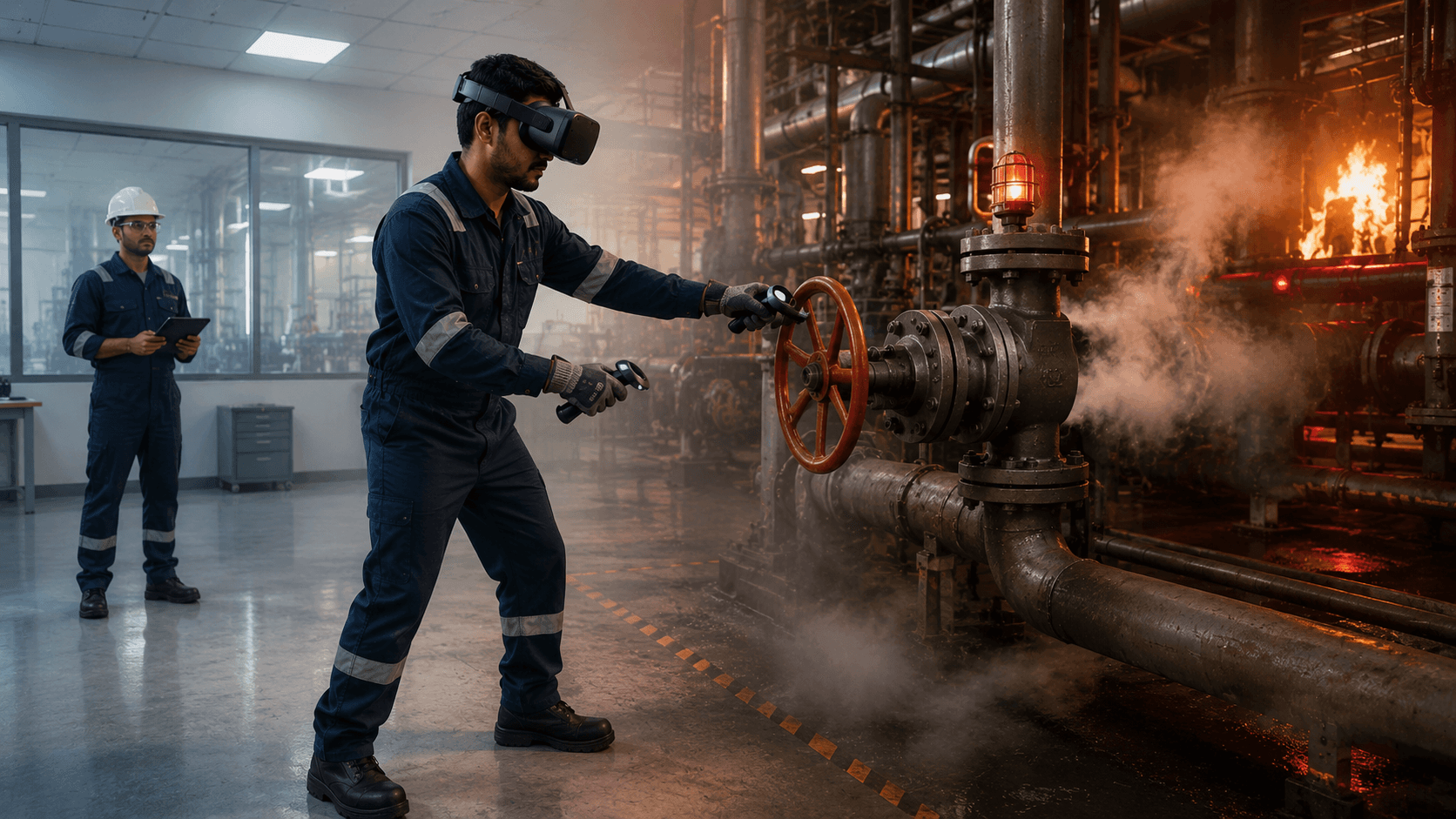
Let's be clear: immersive technology isn't a replacement for everything.
- If a 2-minute video works - use the video.
- If hands-on practice with real parts is safe and available - do it.
- But when you're dealing with high-cost equipment, hazardous environments, complex sequences, or scenarios too dangerous to recreate - VR and MR are not just nice-to-have. They're strategic necessities.
The right question isn't "Where can we use VR?" It's "Where is the biggest gap between understanding the procedure and being ready to perform it?"
That's where immersive learning delivers measurable ROI - through fewer errors, faster ramp-up, better retention, and safer operations.
One Ecosystem. Multiple Learning Pathways.
At DigiFox, we don't offer a single solution - we offer an integrated ecosystem:
- VR Safety Experience Center - for emergency drills and hazard response
- VR SOP Training - for interactive procedure mastery
- MR Workbench - for digital guidance on physical equipment
- TMS Analytics - for tracking progress and identifying gaps
All backed by in-house 3D modeling, animation, and end-to-end development - with ISO 27001 and SOC 2 certification for enterprise-grade security.
The Future Isn't VR vs. Traditional - It's Both, Working Together
SOPs still matter. Trainers still matter. Classroom sessions and hands-on practice absolutely still matter.
Immersive technology adds what traditional methods can't: a safe, repeatable, data-driven space to experience and practice before real-world consequences begin.
The learning journey becomes complete:
Learn → See → Experience → Practice → Apply
For employees, that means walking onto the floor with genuine confidence. For organisations, that means a workforce that's faster, safer, and better prepared - without risking production, equipment, or people.
Ready to Turn Your Procedures Into Experiences?
If you're exploring VR industrial training, safety simulations, SOP training, or Mixed Reality workforce development, DigiFox can help you identify where immersive tech fits - and where it doesn't.
#### Let's talk. [https://digifox.studio/] – and let's build training that actually prepares people for what's real.